
Candle Craft 13: Fractal Storytelling
By Royal McGraw
Royal McGraw has written professionally for film, television, comics, and games for over 20 years. He led development on the mobile smash hit Choices: Stories You Play and currently serves as CEO of Candlelight Games.

Welcome! This is the 13th installment of a multi-part series intended to provide you with quick and actionable adjustments that you can make to your own writing process to improve your storytelling.
In the previous Candle Craft, we discuss how you can use Edgar Allen Poe’s Unity of Effect to ensure every narrative element of your work works to elicit a specific emotion from your audience. Today, we’re going to zoom out into a more conceptual topic – fractal narratives.
Fractal Shapes
Fractals are shapes that appear self-similar at arbitrary scales. This means that zooming in and out yields images that are similar. The most famous fractal is probably the Mandelbrot set. Fractal structures are also common in nature, like in plants, sea shells, and rivers.

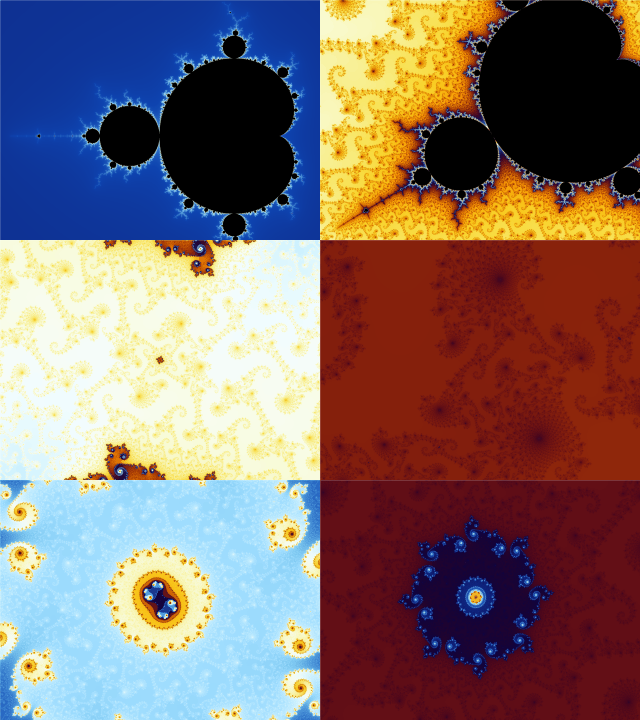
Credit: Paul Oomen / Getty, from https://cosmosmagazine.com/science/mathematics/fractals-in-nature/
These fractal structures are also apparent in storytelling.
Fractal Storytelling
When we open our minds to the idea, we can see that every single lesson you can apply to any scale of storytelling applies to every other scale. As an example, in the second installment of Candle Craft, we discussed our definition of story as “change”. Then two-beat storytelling leveraged this idea, using beginning and end states to highlight the distance traveled:
Each story conveys change, visualized as Two Contrasting Beats.
Each act conveys change, visualized as Two Contrasting Beats.
Each scene conveys change, showcased as Two Contrasting Beats.
Each line conveys change, showcased as Two Contrasting Beats.
The same is true of Undermine & Underline; The Story Mind; Matriarch, Patriarch, Scholar, Fool; and The Spider Test.
The Fractal Spider Test
An enormous spider skitters across the floor and pauses in the middle of a group of friends. How does each friend react?
This exercise is an incredibly powerful tool for ensuring that each of your characters reacts differently to narrative events. But each of your scenes exists in a narrative too, and they also react differently to what has come before via But and Therefore. Thus, you can apply the Spider Test to your scenes the way you can to your characters. How does each scene react differently? What makes each scene unique? Does your tactical storytelling evolve across the story?
Each of your scenes exists in an act. Assuming a 4 or 5 act structure, each act will voice a different argument – it could be triumph, failure, approval, rejection. No act will have quite the same point of view, so no act will “speak” in quite the same way.
And lastly, your story itself speaks with its own distinct voice. What separates its aesthetics from other works in the genre? What is its unique vocabulary, cadences, and rhythms? What gives it Unity of Effect?
Why Fractal Storytelling is Powerful
Fractal Storytelling is powerful because it greatly reduces the number of best practices you need to keep in mind. Every lesson that we’ve covered in Candle Craft is equally useful at every narrative scale because your story structure is self-similar. Characters are not just description, arcs, or lines of dialog – they are ALL of those things and all of those things are the same.
Lastly, Fractal Storytelling is powerful because it informs rewriting.
Rewriting
You’ve probably heard the phrase that “writing is rewriting.” This is absolutely true.
But I’d like to point something out. The word “rewriting” makes it sound like you are writing your story again to be different. Nothing could be further from the truth. Great rewrites make the story more like itself.
Rewrites leverage the power of Fractal Storytelling to shape your narrative at each scale to more closely resemble itself at all other scales.
TIP #7: Recognize that storytelling is fractal: every storytelling lesson you’ve learned and every great idea you bring to your work is part of a unified self-similar fabric.
Done right, your story resembles itself at every scale.
Next time, we’ll discuss How To Get Started Writing.