
Candle Craft 17: Replay Value
By Royal McGraw
Royal McGraw has written professionally for film, television, comics, and games for over 20 years. He led development on the mobile smash hit Choices: Stories You Play and currently serves as CEO of Candlelight Games.

Welcome! This is the 17th installment of a multi-part series on how to improve your writing process and storytelling.
Last time was Part 1 of a two-part series. We’re reacting to an article from GameDeveloper.com called “Opinion: When choice becomes a metric, narrative design suffers.” The subhead to the article reads: Professor and game developer Nicholas O'Brien argues for subtlety in player choice and consequence, versus the "Clementine will remember that" route: "By overtly validating a player’s choice as 'mattering' you unintentionally subvert their agency," he says. I encourage you to read the article and to visit the Steam page of his narrative game The Last Survey.
As a reminder, in the article, a playtester provided O’Briend with two reasons why they thought the Choices Matter tag was improperly applied to The Last Survey:
The Last Survey didn’t immediately communicate that choices had direct consequences
Regardless of choice, the game didn’t provide much opportunity for replay value.
This playtester has brought up two of the most important and foundational ideas of interactive narrative: interface feedback and replay value. Last time, we covered interface feedback. This time we’re covering replay value.
What Is Replay Value?
In gaming, the term “replay value” gets thrown around a lot. Depending on the context, it can mean a few different things. Most commonly, and in the way the playtester is using it, replay value means:
New or different game content accessible on a second playthrough, usually requiring different steps or decisions to be made.
By this definition, a game would have replay value if it offers:
Branching decision trees with observably different outcomes
Unlocked higher difficulty mode
Unlocked new levels
But I want to push back against this definition, not because it’s wrong, but because it fails to state the obviously true criteria. To me, replay value is defined this way:
A game that is so good that you want to play it again.
Everything else – branching decisions, unlockable difficulty modes – those only matter if you actually want to spend more time with the game. If the game sucked, and you stopped after 15 minutes, do you care what happens 15 hours later?
When players want to spend more time in the game world, branching decisions with big consequences motivate additional playtime.
Replay Value Is Mostly Marketing
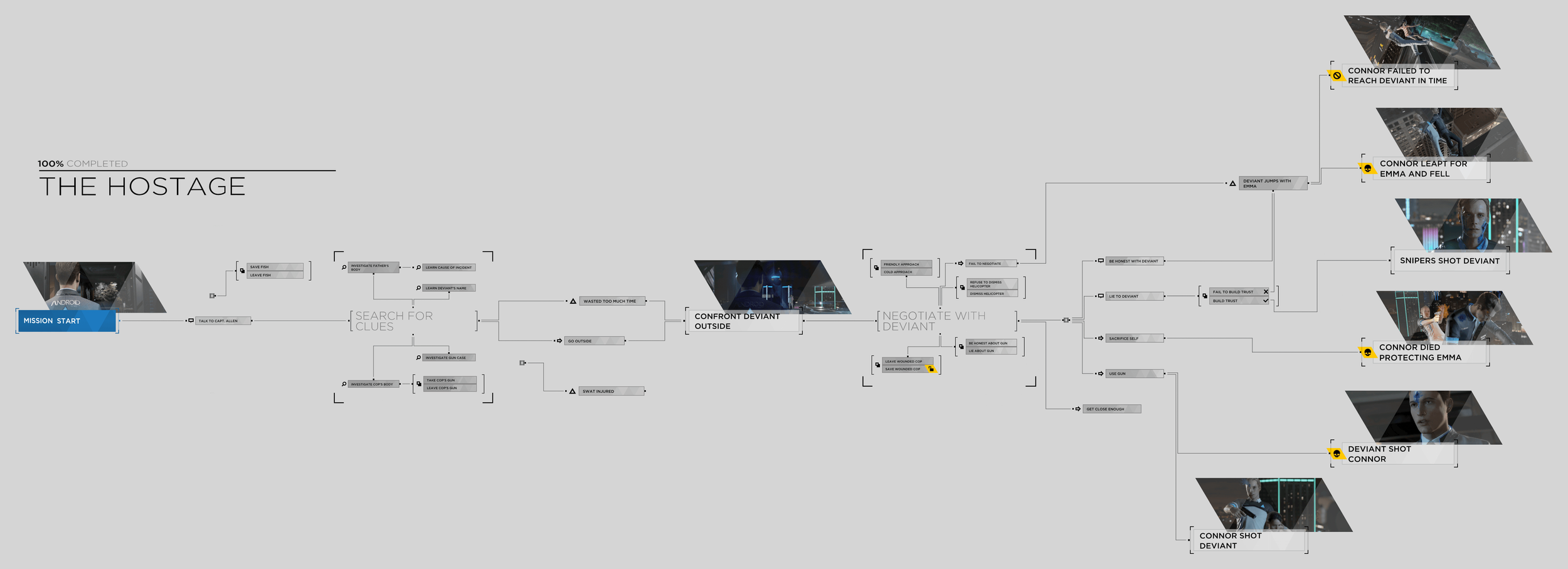
Now that we understand that big branching decisions are an excuse to play more, we can see that the flowcharts in Detroit: Become Human are, in some ways, mostly marketing!
According to psnprofiles.com, only 62% of players completed Detroit: Become Human once.

We know then that 38% definitely didn’t see alternate complete paths through the story. But every single one of those players knew that alternate paths existed, and that fact captures the imagination.
This technique is not new. Going back to Choose Your Own Adventure books, we can see that they were commonly advertised as having a huge number of endings.

38 endings! That is so many! Other than the author, has anybody read them all? Does it matter? This is clearly good ad copy.
Don’t Chase Replay Value
So given everything in the section before, I would advise most game designers to focus their energy on making the best game possible. If your game is great, players will come back. If players come back, then you can give them more.
But if your game needs work… well, all that work on replay value might have found more use getting the game to a better state. Games that aren’t played, are also not re-played.
Now, specifically for writers of interactive fiction, one additional word: If you have done your job correctly – that is, provided good choices – then your game automatically includes an excuse for players to replay.
Let’s look at a flow chart from Detroit: Become Human:
And now let’s compare that to a flowchart from a Choose Your Own Adventure book.
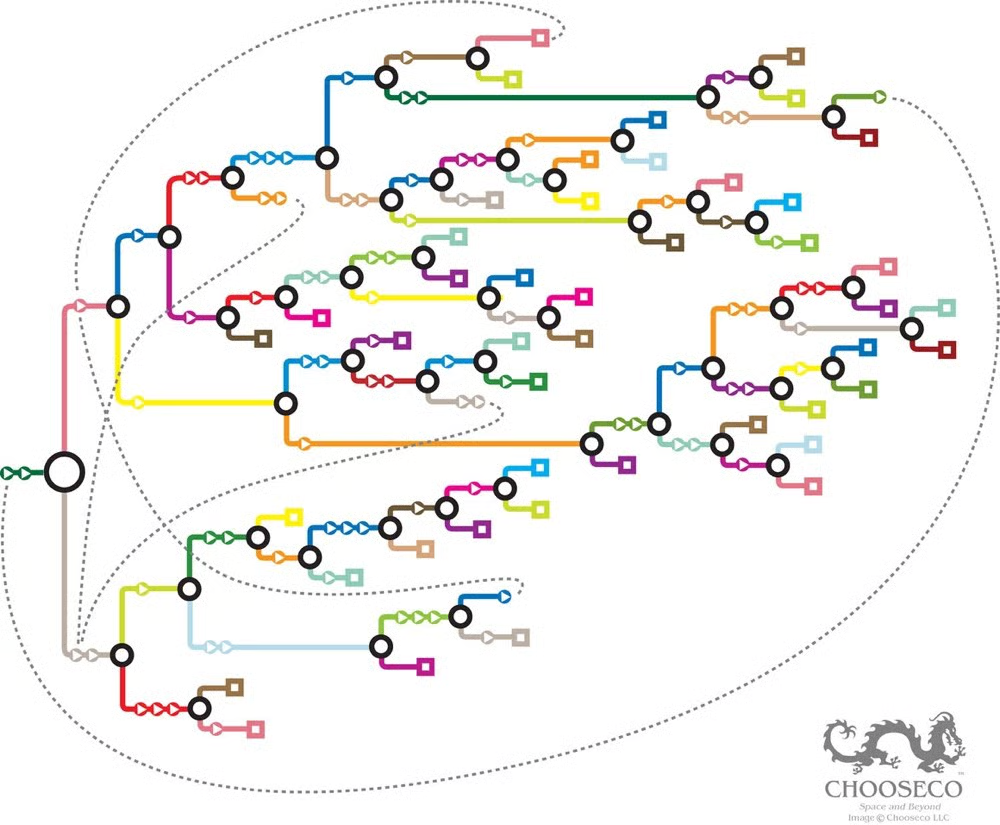
What becomes immediately obvious in the comparison is that both Detroit: Become Human and Choose Your Own Adventure books barrel forward relentlessly. There are no truly right answers here, just many possible answers that can each lead us to a new situation.
This is “Yes, and… “ thinking, and it is crucial to good interactive fiction.
And yes, this is also replay value, motivated by player curiosity. What else could happen?
Moving Forward
So bringing this all the way back around, how could O’Brien adjust The Last Survey keep its focus on advocacy and still honor player choice? For starters, we could simply not start over. In my experience, “bad” paths take players to some of the most delightfully deranged and consequently most enjoyable places.
In Surviving High School, a game mostly about going to school and going on dates, bad paths regularly resulted in the player character getting:
Expelled from school
Eaten by a bear
Traveling to Europe and committing a cross-country crime spree
Zombies!
In a word: fun!
So in The Last Survey, we could ask some other questions?
What if the player character fails, and the world descends into chaos ten years later?
What if the executive gets so angry he has a heart attack and dies?
What if the player character leaves in defeat… but does so by jumping out the skyscraper window?
What if the player takes the executive hostage, and now we have a high-stakes negotiation?
All of these would be opportunities to not only delight the player, but add in some additional elements that underline or undermine the advocacy theme. And as a bonus: they might also add some replay value… not that we’re trying to chase it.
TAKEAWAY: Replay value arises from making a great game. Making a great interactive fiction game starts with honoring player choice.
In Conclusion
A big thank you to Nicholas O'Brien for writing the GameDeveloper.com article that we reacted to today. Writing about your own work takes an immense amount of courage. I do hope each and every one of you reading this checks out his article, and takes a look at his game on Steam.
What does replay value mean to you? What games do you think have good replay value? And if you have any other articles or videos you’d like me to react to, please share!
Until next time!