
Candle Craft 15: Narrative Tools
By Royal McGraw
Royal McGraw has written professionally for film, television, comics, and games for over 20 years. He led development on the mobile smash hit Choices: Stories You Play and currently serves as CEO of Candlelight Games.

Welcome! This is the 15th installment of a multi-part series intended to provide you with quick and actionable adjustments that you can make to your own writing process to improve your storytelling.
The Impossible Tool
Like most writers who’ve built a career in the games industry, I’ve used dozens of different tools to craft interactive narrative over my decades of experience. Well, “worked and played” would be even more correct to say. I find these tools fascinating, and I enjoy exploring them in my free time as well.
Interactive fiction tools, sadly, have the distinction of being created by people who rarely use them in depth, often using them only so far as creating a quick demo. They seem easy. After all, it’s “just words.” It turns out, they’re anything but.
Interactive narrative tools are charged with an impossible task, and they accomplish that aim with varying degrees of success. That impossible thing is, of course, conveying distinct, mutually exclusive eventualities simultaneously — and making them readable, editable, testable, and shippable.
Things to Consider
Recently, I came across this article by Robin-Yann Storm. She makes many good points:
Every writer has their own technique
Writers should be able to “just write”
Writing is interconnected
These are all true and worthy, but we’re missing another important consideration. I’d like to add one more to her list:
4. Writing is re-writing
Earnest Hemingway put it more bluntly.
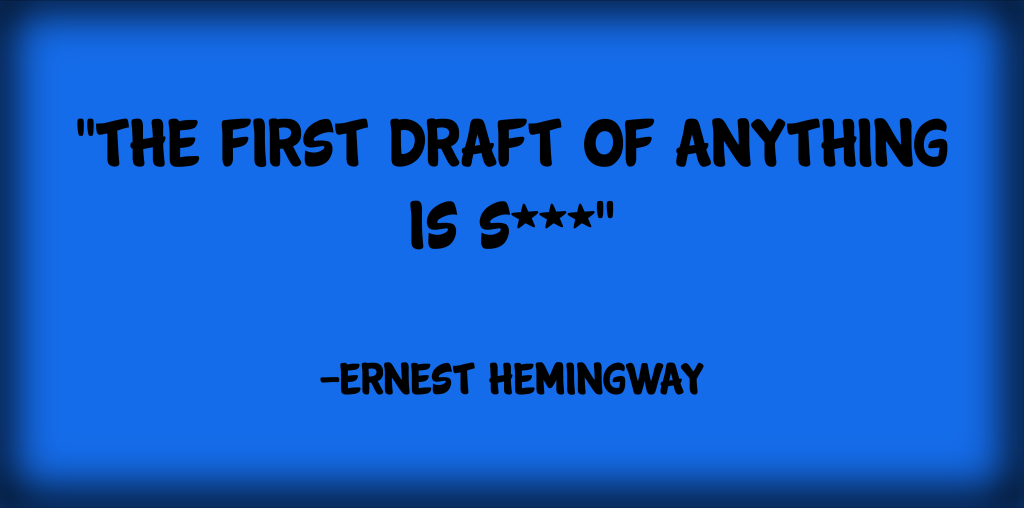
Writing is Re-Writing
For most writers, working within a professional context, the first draft is about 20% of the commitment. Subsequent drafts and edits will change varying amounts of text – sometimes you’ll swap out huge chunks or maybe all you needed to add was a missing comma.
Either way, at some point, you’re in the tool, and you’re making changes. This process never ends; it just pauses mid-stride… because the producer called “pencils down,” the game shipped, or god forbid, was cancelled.
Design as Performance
Screenwriters often rewrite dialog when an actor gets cast in a role. Obviously, you wouldn’t give Christopher Walken and Christopher Eccleston the same exact dialog. They chew their words differently. Their sentences break differently.
For games that present text directly, most writers will have had the uncomfortable realization that the on-screen UX makes everything read… wrong, somehow, like an actor suddenly speaking in the wrong accent.
The UI your players see is an actor. You’re never quite sure how the UI will play the role until you see it yourself performing live.
Context is King
Some projects need more aggressive and intrusive rewrites than others, and some tools handle rewrites better than others. Tutorial text is tutorial text. Google Sheets works just fine, as does scripting directly into JSON, or a node graph editor in Unreal. The context is simply the flow. But what about emotional rhythm? How a scene breathes?
If you need good narrative context – where a line of dialog fits in a scene, in an arc, in a game – then it helps to have a dedicated tool that can provide that to you quickly and cleanly.
Questions to Ask
This is the list of questions you need to ask your team. These questions will help you determine if interactive narrative is set decoration or a core production pillar.
On a scale of 1 to 10, 1 being lowest and 10 being highest:
How much text is in the shipped game?
How frequently will that text be edited in the tool during production?
How core is the quality of the text to the success of the shipped game?
How much additional text will ship post-launch?
If the answer is a 7 or above to any of the above questions, then everybody on the team needs to step out of their comfort zone and facilitate writing tech that favors rewrites over any other factor.
What Qualities Favor Rewrites
Just like there is no perfect software for writing, there’s no perfect software for rewriting. However, the list of considerations is easier to articulate:
How shareable are drafts to people without a license?
Can writers see and understand multiple branching paths in context?
How quickly can an edit be made and then played?
How quickly can an edit be made and then shipped to players?
Is version control friendly to rewrites?
Would a code freeze impact writers working on unrelated future content?
Ask yourself these questions and then exclude any software that does not meet your criteria.
Re-Writing is the Real Feature
Stories in games are living systems. They bend under UX constraints, react to performance realities, expand post-launch, and mutate under production pressure. Any tool that cannot support that evolution will quietly fight the very thing it was built to enable.
The “impossible tool” may not exist, but we can get closer by designing our pipelines around iteration instead of origination. In the end, interactive storytelling isn’t about shipping words; it’s about shaping and then reshaping them over and over until they come alive.
Your Turn
Now it’s your turn to let me know. What is your favorite interactive writing tool, and why do you like it?