
By Royal McGraw
Royal McGraw has written professionally for film, television, comics, and games for over 20 years. He led development on the mobile smash hit Choices: Stories You Play and currently serves as CEO of Candlelight Games.

Welcome! This is the 23rd installment of a multi-part series on how to improve your writing process and storytelling.
In previous installments of Candle Craft, we've talked about the importance of understanding what players want from interactive stories. But what happens when two players want completely different things from the same story?
Consider two people playing a romance game. The first player has fallen hopelessly in love with one of the characters. They carefully consider every interaction, agonize over romantic decisions, and look forward to the next opportunity to spend time with their favorite love interest.
The second player is following a walkthrough. They know exactly which dialogue options will earn the most affection points. They intend to romance every available character, unlock every scene, and collect every ending.
Both players are enjoying the same game. But… are they even playing the same game?
Different Strokes
A recent academic paper, Romance Changes Everything: Player Engagement with Romantic Video Game Content by Christine Tomlinson and Amy Brierley-Beare, explores the different ways players engage with romance in video games. The researchers identify four broad modes of romantic engagement:
Emotional: Players who become personally invested in fictional romantic relationships.
Strategic: Players who approach romance as a system to understand, manipulate, or master.
Incidental: Players who engage with romance as a secondary part of a larger gaming experience.
Spectatorial: Players who enjoy observing romantic relationships and their development.
These aren't necessarily four mutually exclusive groups of people. A player might engage emotionally with one romance and strategically with another. Their motivations might even change over the course of a single playthrough.
But the distinction raises some interesting questions for game designers. Most importantly, what happens when the things that make a game satisfying for one kind of player make it less satisfying for another?
Love Is Not a Number… Unless It Is?
Let's start with a familiar mechanic. You're playing a romance game. Your love interest has just confessed something deeply personal. Perhaps they've revealed a painful memory, admitted a terrible mistake, or expressed a fear they've never shared with anyone else.
The game offers three responses:
"Thank you for trusting me."
"You shouldn't let that bother you."
"We all have our problems."
One of these responses earns ten affection points. Another earns five. The third earns nothing. For the strategic player, this is a straightforward problem. Which answer produces the best result?
But the emotionally engaged player may be asking an entirely different question. What would I say to this person? Or perhaps, what would the character I'm roleplaying say?
This illustrates a tension between two of the most important promises an interactive romance can make to its players. The first is that the player's choices allow them to express themselves within a romantic relationship. The second is that the player's choices allow them to succeed within the framework of the game. These promises aren't necessarily incompatible. But they aren't identical either.

The Perfect Partner
Consider Mystic Messenger, the 2016 mobile romance game from Cheritz. The game simulates a messaging application in which players participate in conversations with a cast of potential romantic partners. Dialogue choices can earn colored hearts associated with particular characters. Accumulating the right hearts helps determine which romantic route the player enters. Once on that route, further choices and participation affect which ending the player receives.
In other words, the game has a fairly explicit system for measuring romantic success, and players have developed extensive guides explaining how to navigate it.
From a game design perspective, this works. Players can learn the system, improve their performance, and pursue a desired outcome. But consider what this means from a narrative perspective.
The optimal strategy is to become exactly the person your love interest wants you to be. If they appreciate confidence, choose confident responses. If they prefer vulnerability, be vulnerable. If they dislike confrontation, avoid confrontation. The relationship becomes a puzzle, and the solution to that puzzle is to tell another person exactly what they want to hear.
Likewise, if every disagreement costs affection points, players quickly learn that disagreement is something to avoid. The system may inadvertently teach players that the best romantic relationship is one without friction, even when the writers are trying to tell a more complex story.
Approval Is Not Affection
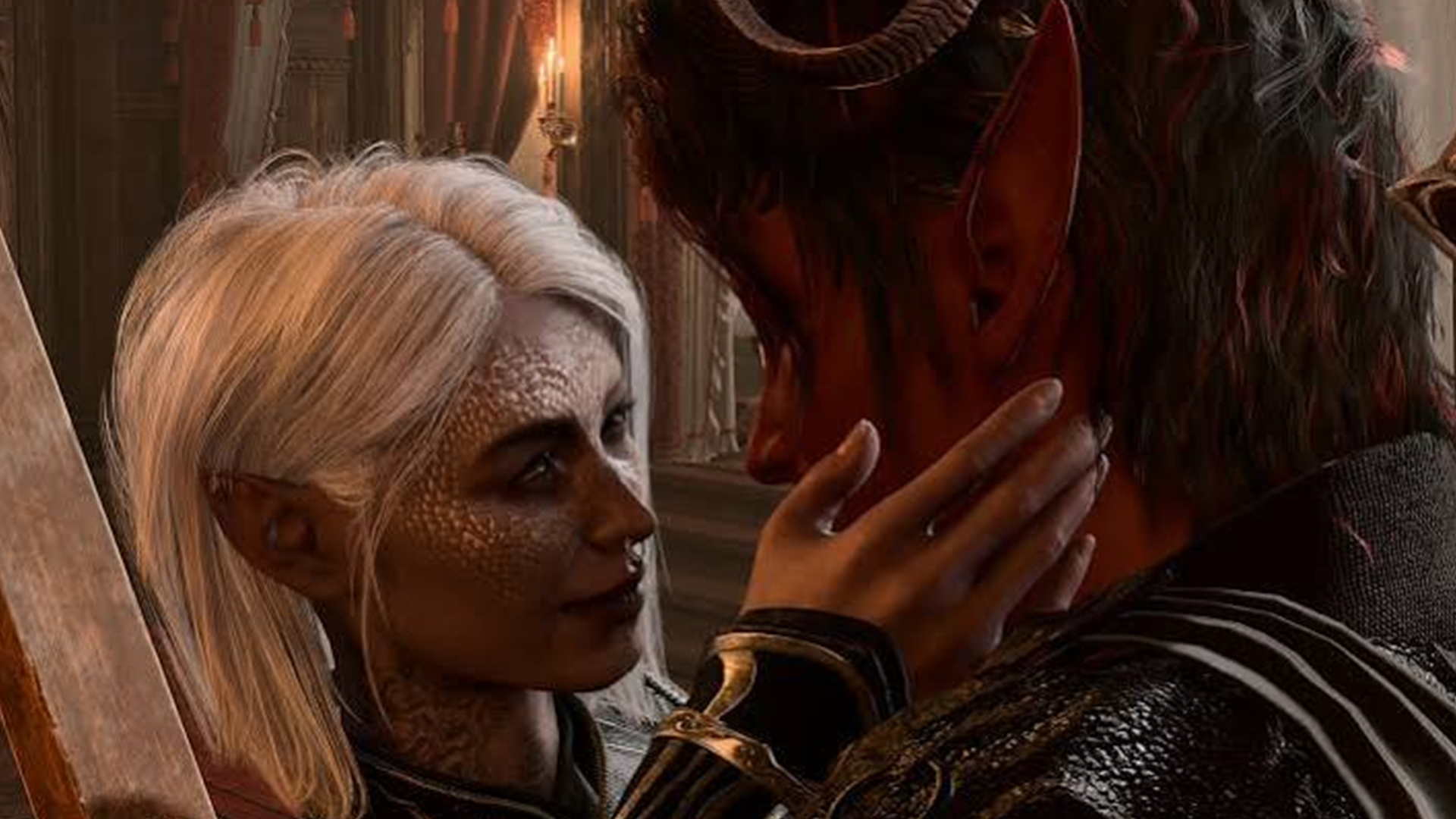
Now consider Baldur's Gate 3. Like many role-playing games, Baldur's Gate 3 uses an approval system to track how companions feel about the player. Companions approve or disapprove of decisions made during conversations, quests, and other interactions. Those reactions accumulate into numerical approval ratings that influence relationships and access to certain scenes.
But the important distinction is that approval is not identical to romance. A companion's approval can help establish the conditions for a relationship, but romantic progression also depends on conversations, personal quests, and particular story events.
This creates an interesting dynamic. You might make a decision because you believe it's the right thing to do, even though you know that a companion will disapprove. And that disagreement can be meaningful.
Astarion and Karlach, for example, have very different personalities, values, and attitudes toward the world. Decisions that appeal to one character won't necessarily appeal to the other. The player is therefore encouraged to think about compatibility, rather than simply selecting universally positive responses.
But the broader structure creates opportunities for a different kind of romantic engagement. The player isn't just choosing what to say during a date. They're establishing a personality through decisions that have consequences across the entire game. And the romantic relationship develops within that larger context.
Of course, Baldur’s Gate 3 is hardly immune to guides either. Players can still optimize approval and pursue particular romantic outcomes. But there's an important difference between choosing the right answer to make someone fall in love with you and making a decision about the world that happens to make someone fall in love with you.

Photo from Episode: Choose Your Story
Designing for Different Kinds of Love
So how should designers approach these competing motivations? I don't think the answer is to choose one audience and ignore the other. After all, strategic engagement and emotional engagement aren't mutually exclusive. Many players enjoy understanding the mechanics of a game while simultaneously becoming deeply invested in the characters they romantically pursue.
The better approach is to recognize that different systems serve different player motivations. Here are three actionable things you can do:
❤️ Make romantic progress about understanding, not perfection.
Instead of requiring players to select the optimal response in every conversation, allow relationships to develop through a broader pattern of decisions. Just like in life, a single disagreement shouldn't necessarily destroy a relationship. Characters might even respect a player who challenges them, even when they disagree!
❤️ Separate narrative commitment from collection completion.
Players should be able to pursue one relationship without feeling that they're failing to engage with the rest of the game. Likewise, players who want to experience every route should be able to explore those paths. Scene replay, alternate save slots, and route-selection tools can help completionists explore additional content without requiring emotionally invested players to abandon their preferred relationship.
❤️ Provide clarity without eliminating discovery.
Strategic players need enough information to understand how their choices affect the game. Emotional players need enough information to understand what they're expressing through those choices. A choice interface doesn't necessarily need to reveal that this specific response awards ten affection points. But it should give players a reasonable understanding of what their character is about to say or do.
The Heart of the Matter
Tomlinson and Brierley-Beare's research is a great reminder that romance isn't a single kind of gameplay. For some players, romance is a fantasy of emotional connection. For others, it's a challenge to master. For still others, it's a supporting element of a larger adventure, or a story they enjoy watching unfold. And many players move between these different modes.
A well-designed romance game can satisfy the player who wants to collect every ending as well as the player who only wants to fall in love once. But to do that, we need to remember that these players may be looking for entirely different kinds of rewards.
That's what makes designing romance games so challenging… and fun.